Under the sublime masters' care |
|
|
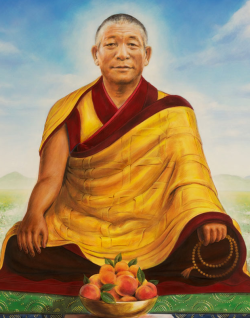
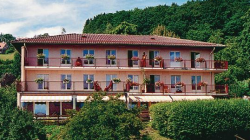
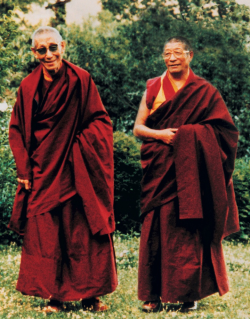
A short history of the Rabten Monasteries as personal experience by a close disciple of Geshe Rabten Rinpoche: When the Venerable Geshe Rabten explains the Buddha's teachings, then even we Westerners can clearly understand everything, were the frequent words of a friend in the early seventies. In 1975 this great master came to Switzerland and we had the opportunity to request teachings. As a result of Geshe's fine explanations, interest in Buddhism grew quickly. About one year later, after completing my studies of electronics, I decided to spend the years to come in Geshe's vicinity, learning the Tibetan language and receiving direct instructions from this great master. In 1977 Geshe founded the Centre for Higher Tibetan Studies on Mont-Pèlerin overlooking lake Geneva. Right from the very beginning, the centre was a true monastery where the rules of Vinaya were observed. All the students made effort to master the Tibetan language and followed extensive studies of Buddhism in a manner similar to the studies at the monastic universities of Tibet. Due to Geshe's skilful guidance the students developed excellent qualities within just a few years and soon the centre had several good translators capable to render teachings from Tibetan into various Western languages. In the beginning the monastery's building was rented, but after a few years the owners put it for sale, and we had to either leave it or buy it. Many Western disciples had gathered around Geshe by that time, but hardly anyone from a financially potent background. With no capital available, Geshe requested his disciples and personal friends for help, and many then offered their long-time savings. Combined with a bank loan, the property was bought. Shortly after, our family-estate in Austria came to be split-up among the heirs. My share was a shaggy farmhouse built in 1809 with surrounding meadows and woods. Geshe requested the advice of his root-master Kyabje Trijang Dorje Chang to decide on the use of the property. The reply was, that a monastery on these grounds would bring benefit to the beings, and thus we decided to renovate the building and invited Geshe to use it as a branch of the monastery in Switzerland. Several unusual signs occurred while the new monastery was under construction. Most obvious were the unusually abundant and excellent apples and pears growing on the old trees surrounding the farmhouse. While hardly any fruits grew that year in the surrounding farms, the local peasants mentioned that they had never before seen such a quality harvest on our grounds. Within a few months after moving into Geshe's vicinity, his teachings had changed my attitude to life. I became a monk and intensively studied the scriptures. The transformation of the family's old farm-house into a monastery was a new kind of challenge, with regards to activity as well as finances. My mother had offered all her funds for the renovation. But these were soon exhausted and Buddhism being new on the continent, there was no-one interested to substantially support a Buddhist monastery. The monastery in Switzerland was also struggling to meet its financial needs and so I decided to turn to my profession and began to write software. During the following ten years this took most of my time, but was also financially rewarding. The funds acquired were all invested to turn the old farm-house with its barns into a monastery with prayer-hall and living quarters. Geshe gave us many teachings, they were always very clear and moving. Even most subtle points seemed quite at reach through Geshe's words. So we took this as a given quality of Tibetan teachers. When the amount of time Geshe could spend for us became more limited, Geshe sent other great teachers to the monastery. Soon we had to realize that it was much more difficult to acquire a clear knowledge from their discourses. Once, after having received instructions from a great abbot, I had the opportunity to visit Geshe and discuss my progress. One month was spent making every effort to gain a clear understanding of the subject, but in vain. Then, just half an hour of discussion with Geshe easily brought clarity to the complete subject. Such experiences made me realize that masters, capable of elucidating Buddha's thoughts so clearly and easily, are very, very rare. At that time some students requested Geshe to invite masters of other traditions. Geshe kindly agreed and in the months to come several of the most famous masters and leaders of traditions visited the centre. But soon many began to miss Geshe's teachings and remarked: "As famous and great as these masters may be, not one has yet come to equal Geshe Rabten Rinpoche's teachings." Geshe's decision to found a Buddhist monastery in the West was very courageous. Buddhism was virtually unknown in Europe at that time. The sight of a Buddhist monk easily raised suspicion and activities related to an unknown religion were frowned upon. But wherever Geshe appeared, it was sure that people were going to be deeply impressed. Geshe never acted in the name of a specific Buddhist tradition, but introduced the very principle of Buddha's teachings as an universal law showing the basic needs of all sentient beings. Geshe showed the very remedies for the sufferings of all beings as well as the path of abandoning all evil thought as the means to achieve lasting happiness. Geshe's explanations were therefore well appreciated by everyone. These most precious activities of Geshe fully opened the door to the Buddha's innermost intention, a lasting benefit for all beings. Thus Geshe's efforts were truly the work of a great pioneer. In 1981 Geshe's most venerated and beloved root-master, Kyabje Trijang Dorje Chang passed away. In the years to follow Geshe increasingly made remarks of himself being a man of just a few years. Unwilling to accept the meaning of these signs Geshe gave about his intention to leave us, we were deeply tormented when in 1985 Geshe showed repeated fatigue and was diagnosed with an incurable liver ailment. In the months to come we made every effort to request Geshe to remain with us and frequently Geshe agreed. In these days Geshe seemed to loose some weight, but his radiance was visibly getting more intensive. And while we were all down and depressed, Geshe was always joyful and lifting our mood. One day, about half a year after the diagnoses of Geshe's illness, I once again went to meet my master. After arriving at the monastery I opened the door to his room slightly, announcing my arrival. Yet something inexplicable made me enter the room against my intention and Geshe kindly asked me to sit down and spoke to me for over an hour. Geshe then also mentioned that he would come to the monastery in Austria and stay there permanently, as soon as he was well again. A few days later, back in Austria, I woke up in the morning and the thought crossed my mind, that Geshe was still close, but it was not possible to speak to him any more. An hour later we were informed that Geshe had left us. In the days and weeks to come, we were to experience most unusual signs, as they happen, when an enlightened master departs from his physical form fully consciously and fully controlled. |


|
|
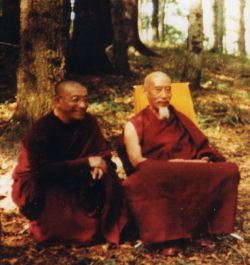
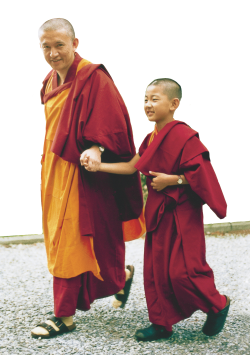
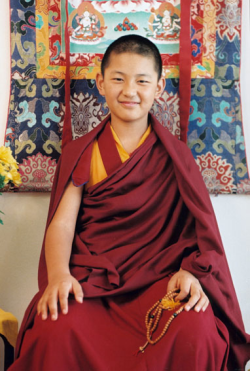
In these most desperate days we placed our only hope in the Venerable Gonsar Rinpoche to continue Geshe's activities. We knew that Gonsar Rinpoche was Geshe's closest and most beloved disciple, so we requested him to be director and abbot of our centres. Rinpoche kindly agreed and initiated many precious activities in memory of Geshe Rinpoche. He also changed the name of the monastery in Switzerland to "Rabten Choeling" and decided to build a stupa in Geshe's memory on the grounds of Tashi Rabten Monastery in Austria. At that time I got a substantial contract with my software activities, which gave me the courage to build the stupa completely in solid marble stone. Ever since the completion of the stupa, many feel Geshe's permanent presence there, just as Geshe had told me in our last encounter, only that it is now in the form of this brilliantly white representation of the Buddha's mind. When in the year of Geshe's departing the time came to prepare for our regular great summer course with one week of intensive teaching and meditation, we requested Gonsar Rinpoche to teach the participants. Rinpoche replied, his knowledge would be exhausted after one day of discourse. Nevertheless we insisted and Rinpoche agreed. After just a few hours of discourse we were deeply impressed and felt, that the loss of our great master was replaced by his most cherished spiritual son, fully capable and dynamically continuing the master's activities with identical clarity and power. In course of time we came to know that the line of Gonsar Rinpoche's incarnations dates back to the very origins of Buddhism in Tibet. These reincarnations are among the most cherished and excellent masters of Tibet's history. Rinpoche's direct predecessor spent many years of his life in Mongolia, with his precious activities reaching far into China. Most of the great Mongolian masters of that generation are his direct disciples, and many disciples are also found in China. The name 'Gonsar Rinpoche' started in the 8th century. The first Gonsar Rinpoche was a great meditator and most renowned master who was appointed tutor of the 8th Dalai Lama. The present Gonsar Rinpoche is the fifth in the line holding this name. Beginning at the age of five he continuously lived in the presence of Geshe Rinpoche for thirty-two years. Under Gonsar Rinpoche's guidance, the centres and monasteries continued to develop in a most excellent manner and many more people began to understand the preciousness of the Buddha's teachings. Rabten Tulku Rinpoche Three years after Geshe had left us, the Venerable Gonsar Rinpoche started to look for Geshe's incarnation. Rinpoche was decided not to accept just a replacement of Geshe, but to find the true incarnation of our great master. Therefore, Rinpoche requested three independent sources to decide on the identity of the child, and was only willing to accept the result, if each of these were to decide for the same child. On the bases of clearly given criteria of time, place, characteristics of family and child, Rinpoche made thorough examinations of 281 candidate children. After months of intensive prayers the replies came, one after the other, and we had the great fortune that each reply indicated the same child. In 1991 we then travelled to India to follow the ceremonies of the official recognition of the boy as the very incarnation of our great master. In the events to follow, many disciples were able to see very convincing signs in behaviour and words of the young Tulku, that gave them a deep certainty of this child definitely being no other than our revered master. When now looking back at the events from Geshe's first indications of not staying much longer with us, then Geshe's most peaceful way of departing and then returning in this very convincing form, it seems like a vividly demonstrated teaching of Geshe, physically showing that it is indeed possible to gain full control over the process of birth and death. We now realize more and more clearly that it was a most convenient planning of Geshe, to suit the time, the situation, and the needs. Also, the very obvious close relationship between Geshe, Gonsar Rinpoche, and the young Tulku, leaves no doubt in us, that the link between disciple and master is the closest and most stable bond, that through our existences will definitely one day lead us to ultimate liberation as well. |
|
